

I saw a note on Substack the other day that made me smile for about half a second before my operator brain took over and started screaming.
Eleri Connick shared a picture from a coffee shop in Copenhagen. Special dedicated cups kept individually for their regulars.
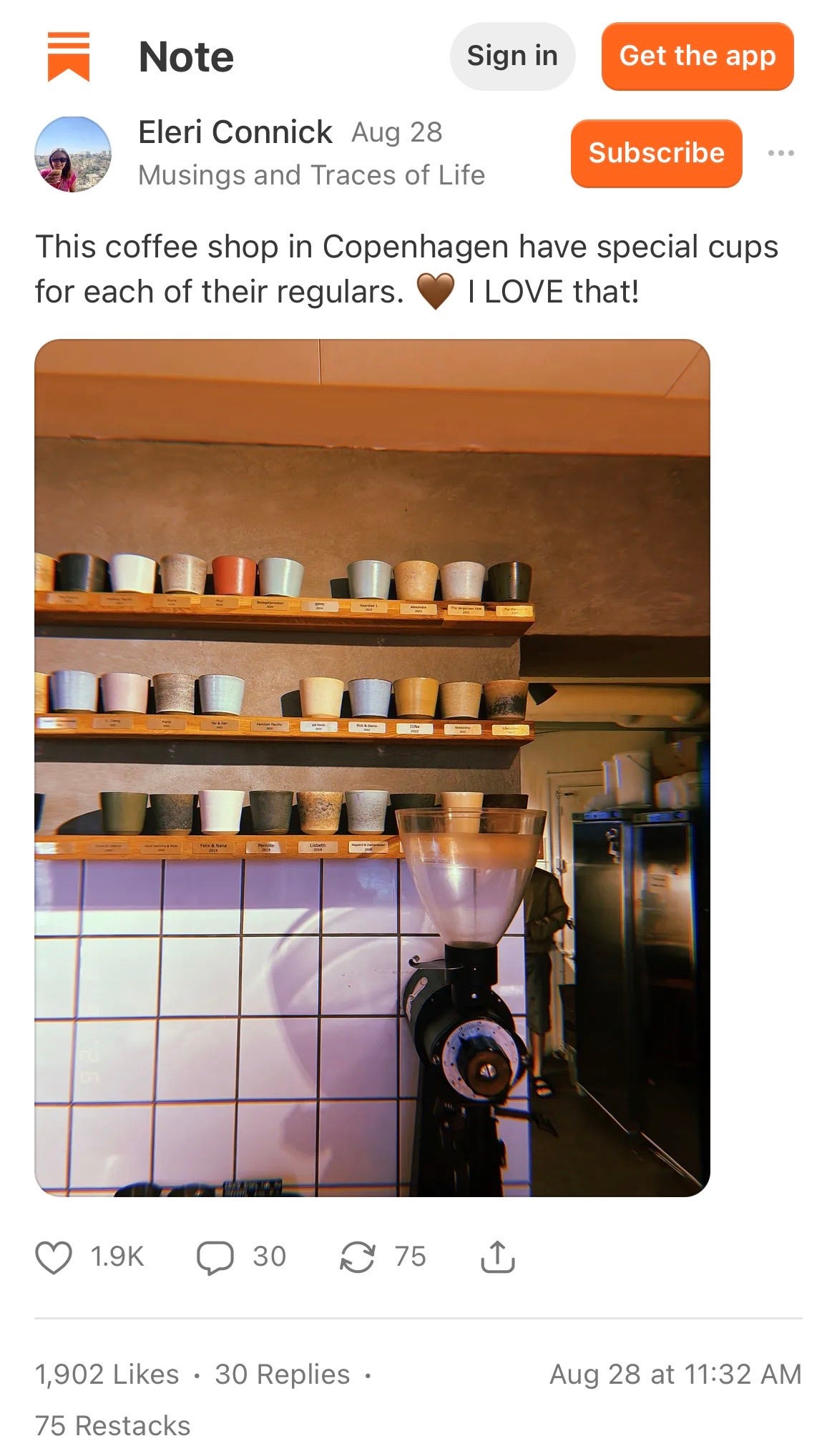
I took a screenshot to share with a founder I’ve been talking to, then immediately started mentally unraveling all the logistics behind it.
When does someone qualify as a regular?
Who keeps track of which cup belongs to whom?
How does a new barista know where Karen’s cup is during a Saturday morning rush?
What if someone puts a cup back in the wrong spot?
What happens if a cup breaks?
What if someone switches their order from a cappuccino to an iced coffee?
What happens if someone doesn’t visit for three months? Can they take the cup with them?
What if a new customer feels left out because everyone around them has one?
At what point does this very sweet idea become 300 ceramic cups and a spreadsheet?
My first instinct as an operator who has experienced what it takes to scale a hospitality concept by 500% was to solve all of those questions.
Make it simple.
Standardize it.
Find a version that creates the same feeling without creating so much work.
Could we find space for storage away from the bar, where the guest has to grab their cup and bring it to the barista? It could be a win-win if staff didn’t have to worry about locating the cup and we didn’t have to ration storage space behind the bar.
The longer I looked at the cups though, the more I wondered if that instinct was missing the point.
Maybe some things are supposed to be a little inconvenient.
My brain has been wired to find friction, inefficiencies, dependencies. The things that will make you want to pull your hair out if you try to scale them as they are.
That instinct matters. I’m not trying to romanticize inefficiency.
But there’s a difference between unnecessary friction and intentional effort.
Sometimes inconvenience is the price of making someone feel seen.
I view hospitality as a way to be in service to other people. And serving people well isn’t always the most efficient option.
Sometimes the extra step is the whole point.
These coffee cups have given me a lot to think about this week. I think the extra human effort can be worth it when you’ve deliberately chosen a place you want to spend it.
Maybe the cups are worth the spreadsheet.
I love this Landon! Efficiency shouldn’t always be our aim. Otherwise, we’re really not after love & service of our customer.